









Pixel Breeder — Interactive Evolution of Procedural Art
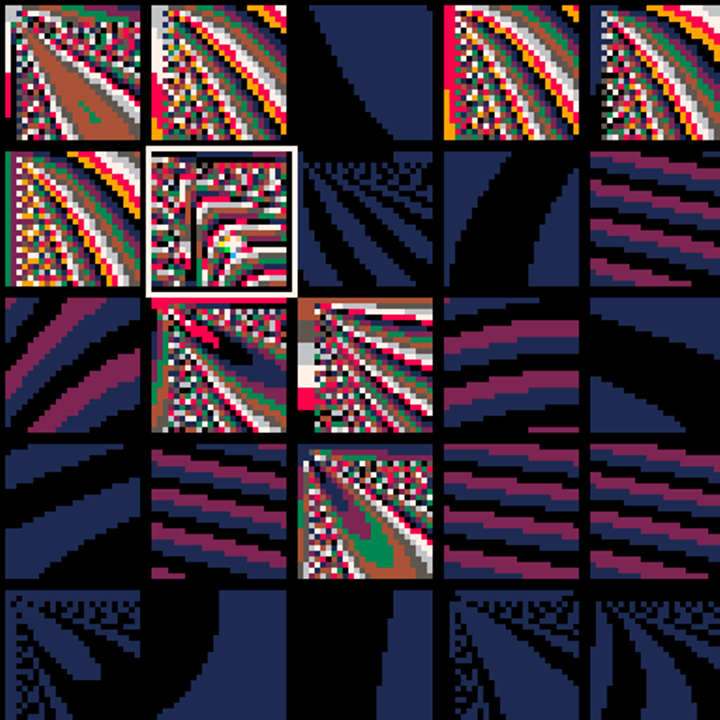
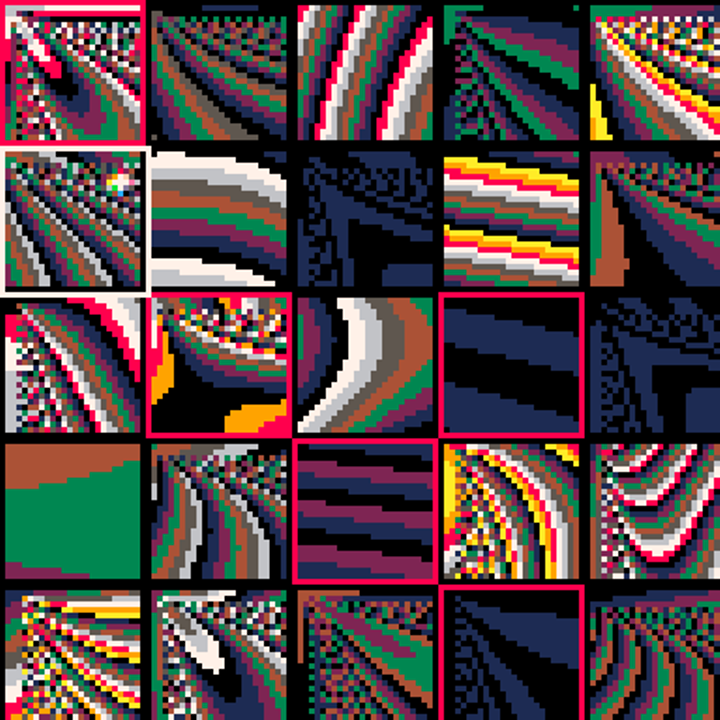
Pixel Breeder is an interactive evolution tool inspired by Picbreeder, developed for the PICO-8 fantasy console. This project's inspiration comes from my research interest: Evolutionary Computation. This research field is interesting because we focus on understanding the underlying mechanisms of evolution so we can take advantage of it! Be to find a solution to a difficult problem, be it to find a number of different solutions. So this project's main goal was to serve as a "Evolutionary algorithm tutorial" presented as an pixel-generator. Pixel Breeder explores how complex and visually interesting patterns can emerge from simple mathematical functions through evolutionary processes and human-guided selection. Each generated image is represented by a mathematical program composed of operations such as addition, subtraction, multiplication, division, sine, and cosine. Users can select patterns they find interesting and evolve new variations through mutation. The idea is that the user can follow through each evolutionary step and see how art evolves according to their own preference! The user choses the images it likes and the next iteration is made by changing small parts of the math functions that created that image (we call this mutation in evolutionary terms!). The user can change some parameters, such as how many math functions are used, how many colors and also the size of the screen. Test it out! What I did? - Designed and implemented the interactive evolutionary system. - Developed the mathematical representation used to generate visual patterns. - Implemented selection and mutation mechanisms. - Created a real-time interactive experience within PICO-8's technical constraints. What was used? Lua, PICO-8, Evolutionary Computation, Interactive Evolution, Procedural Content Generation, Mathematical Functions. The project explores a central idea in evolutionary computation: interesting and complex outcomes can emerge without explicitly defining what the final result should look like. Instead, human preferences guide the evolutionary process. You can check this 'game' in the link! :D